Essays

A Date To Forget

Doubling down on the Tiananmen taboo – Louisa Lim

To write my book The People’s Republic of Amnesia: Tiananmen Revisited, I spent a lot of time in fast-food restaurants. Not because I like burgers, but because dissidents often favour the crush of diners and the buzz of conversation, believing it complicates surveillance. As I sat in McDonald’s with Bao Tong – who spent seven years in jail as the highest government official to be sentenced post-Tiananmen – he could point out which plainclothes policemen were shadowing him. When I visited Zhang Xianling – who co-founded The Tiananmen Mothers, a group of relatives of those who died when the government troops crushed the democracy movement in Beijing on 4 June 1989 – her first words were: “They knew you were coming.” The police had already phoned her to ask the purpose of my visit, knowledge presumably gleaned from tapping her, or my, phone. The surveillance was explicit by design: an act of intimidation aimed at multiple audiences.

Hidden History

The Playwright Purged after Writing China’s National Anthem

Jeremiah Jenne on Tian Han's literary rise and fall

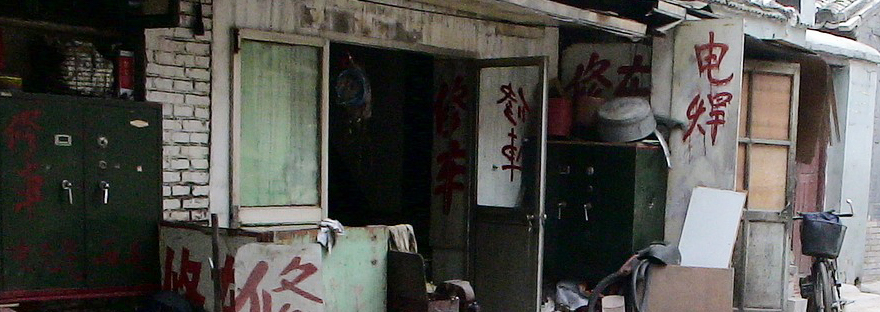
A few meters into one of the less attractive hutongs of Beijing – down the lane from a cheap neighborhood bathhouse, and a boutique coffee shop featuring cold-pressed cruelty-free beans – is a squat grey courtyard that was once home to playwright and author Tian Han (1898-1968), who penned the lyrics to the Chinese national anthem.

A native of Hunan and the scion of an elite family struggling to maintain appearances in a time of declining empire, Tian Han became one of the most influential writers of the post-imperial, Republican era. His work combined a life-long love of Chinese opera with a passion for film and new forms of theatrical expression aroused during a sojourn as a student in Japan between 1916 and 1922. By the 1930s, already an established author known for his radical politics and semi-secretly a member of the Chinese Communist Party, Tian Han tried his hand at writing screenplays.

Chinese Literature Podcast

Not About to See Your Light

Rob Moore and Lee Moore dive into Han Shaogang's Pa Pa Pa

In this episode, Rob Moore and Lee Moore return to the "Root Seeking" authors with Han Shaogong's enigmatic short story about a young child in the countryside who can only say two things: "Papa" and "F#$* Mama." Every time he utters one of his two phrases, the villagers try to divine what he means and what it means for the fate of the village. Does this boy serve as a good leader for the village? Does he destroy the village? The story questions whether or not language means anything, whether we can say stories even mean anything:

Chinese Corner

How June 4th Became May 35th

Evading the censors with a bit of math – Yakexi

May 35th. It may look like a typo to you, but it is a real thing on the Chinese internet. It is one among a long list of code words used by netizens referring to June 4th 1989, when the Chinese government brutally cracked down the pro-democracy protests in Tiananmen Square. Nearly 30 years later, people use courage, creativity and a bit of math skills to commemorate this tragedy.

China is home to nearly 800 million internet users and an ever more powerful censorship machine, locked in a linguistic game of cat-and-mouse. May 35th (wǔ yuè sānshíwǔ rì 五月三十五日) originated in the early days of Chinese social media.

Essays

Something in the Air

Geremie R. Barmé on a Maoist education, and Tiananmen remembered

Tōutīng dítái!

偷听敌台!

The gruff voice barked over the cement trough. I was in the washroom of our dorm building at the Beijing Foreign Languages Institute. He was a Worker Peasant Soldier Study Officer 工农兵学员 (the Maoist term for ‘student’) wearing, even at that darkling hour in the morning, a high-collar blue Mao jacket. Steely faced, his tone was that of warning and accusation. I had no idea that he'd just said:

'You're furtively listening to enemy broadcasts!'